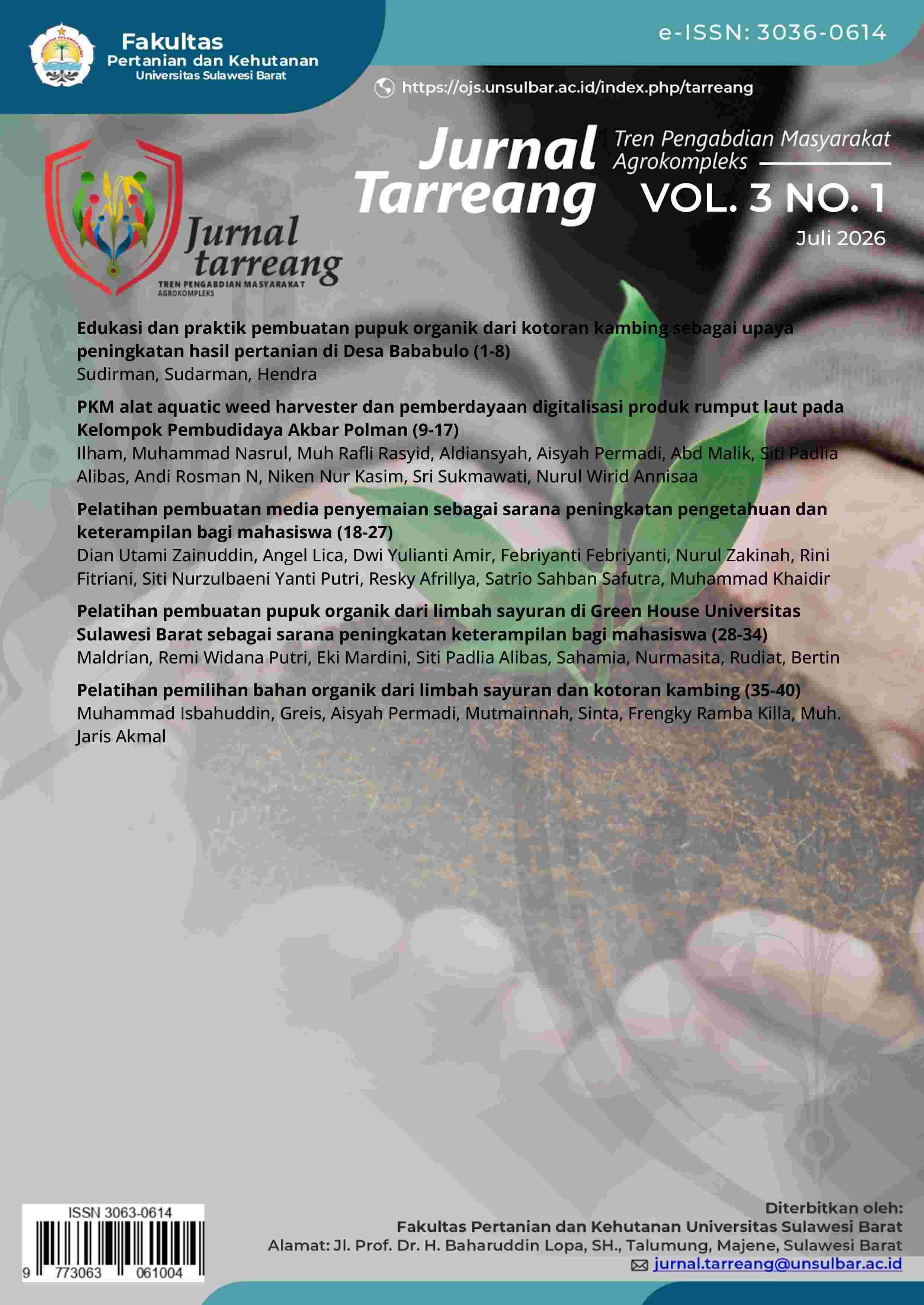
Pelatihan pemilihan bahan organik dari limbah sayuran dan kotoran kambing
Training in selecting organic matter from vegetable waste and goat manure
DOI:
https://doi.org/10.31605/jtarreang.v3i1.6733Keywords:
Compost, Goat manure, Organic matter, Vegetable waste, Waste utilizationAbstract
This training was carried out by students of the Agroecotechnology Study Program Class of 2023 at the Faculty of Agriculture and Forestry Greenhouse, Universitas Sulawesi Barat to understand how to select organic matters from vegetable waste and goat manure to increase student and community knowledge in utilizing organic waste as material for making organic fertilizer. This training was conducted through direct practice on selecting suitable organic matters for composting. The vegetable waste used was free from other food wastes such as rice, side dishes, or inorganic waste. A good vegetable waste as materials compound in composting has a neutral to acidic pH, with types of waste in the form of kale, cabbage, spinach, carrots, and tomatoes because they are easily decomposed and have a good organic content. In addition, the animal manure used was goat manure that was dry or had been stored for a long time, making it safer and better to use than fresh manure. The results of this training showed that participants were able to understand how to select the right organic matters to produce quality compost fertilizer. This hopefully increased public awareness of utilizing household and livestock organic waste in an environmentally friendly manner.
References
1. Syafi’i AR, Sugiarto T, Wulandari AS, Putri MH, Ayyubi AM. Pemanfaatan limbah rumah tangga sebagai pupuk organik di lahan pertanian Kelurahan Jrebeng Kulon. J Ekon Pertan dan Agribisnis. 2025;3(1):41–5.
2. Karim I, Utami A. W, Angka AW, Kasmiati K, Zakiyah AM, Adhisty WA, et al. Green and clean campus melalui sosialisasi pengelolaan sampah dan limbah organik terpadu berkelanjutan. J Tarreang Tren Pengabdi Masy Agrokompleks. 2026;2(3):88–95.
3. Karyanto SA, Pungut, Widodo. Pupuk organik cair dari limbah sayur (kangkung, bayam, sawi). J Tek WAKTU. 2022;20(1):49–54.
4. Akbar A, Aldiansah A, Kuncoro JA, Dasmin D, Aswad H, Renol R, et al. Pembuatan pupuk organik padat dari sisa sayuran dan buah di Green House Universitas Sulawesi Barat sebagai sarana pemberian ilmu bagi mahasiswa. J Tarreang Tren Pengabdi Masy Agrokompleks. 2026;2(3):82–7.
5. Rahmawati TI, Asriany A, Hasan S. Kandungan kalium dan rasio C/N pupuk organik cair (POC) berbahan daun-daunan dan urine kambing dengan penambahan bioaktivator ragi tape (Saccharomyces cerevisiae). Bul Nutr dan Makanan Ternak. 2021;14(2):50–60.
6. Sudirman, Sudarman, Hendra. Edukasi dan praktik pembuatan pupuk organik dari kotoran kambing sebagai upaya peningkatan hasil pertanian di Desa Bababulo Education and training on organic fertilizer production based on goat manure as an effort to improve agricultural yield in Bababulo. J Tarreang Tren Pengabdi Masy Agrokompleks. 2026;3(1):1–8.
7. Ndau WA, Hudin R, Sudirman PE, Ngoni MS. Pemanfaatan limbah daun dan kotoran hewan sebagai bahan dasar pembuatan pupuk organik. J Masy Mandiri. 2023;7(4):3268–77.
Published
Issue
Section
License
Copyright (c) 2026 Muhammad Isbahuddin, Greis Greis, Aisyah Permadi, Mutmainnah Mutmainnah, Sinta Sinta, Frengky Ramba Killa, Muh. Jaris Akmal

This work is licensed under a Creative Commons Attribution 4.0 International License.
Author(s) who publish with the Jurnal Tarreang retain copyright and grant the journal the right of first publication with the work simultaneously licensed under a Creative Commons Attribution 4.0 International License, which allows unrestricted use, distribution, and reproduction in any medium, provided the original work is properly cited.