ADDITIONAL MENU
MAKE A SUBMISSION
MANUSCRIPT TEMPLATE

TOOLS




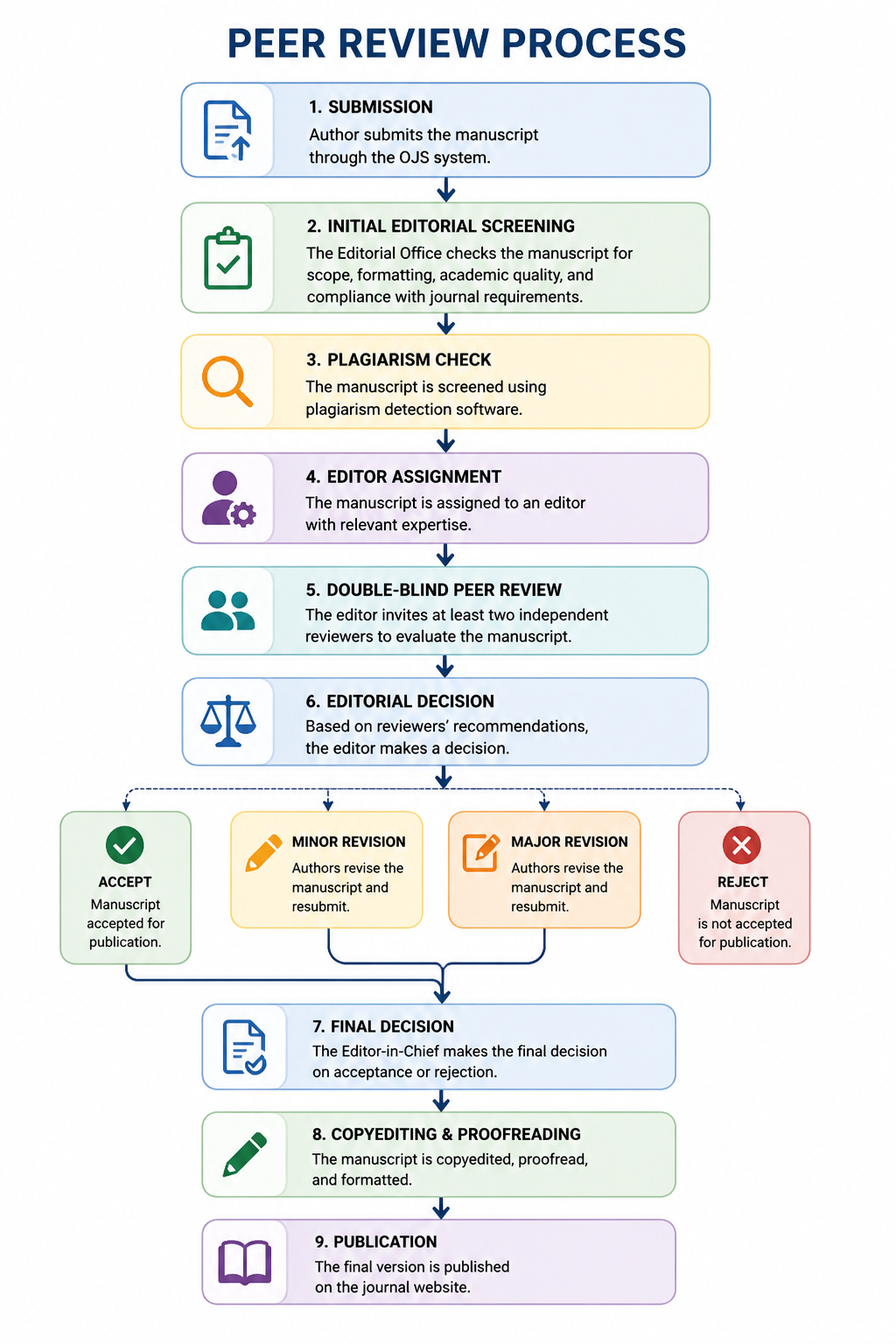
All manuscripts submitted to SIPAMANDAQ: Journal of Physics Education Research and Innovation undergo a rigorous double-blind peer review process to ensure the quality, originality, and scientific contribution of published articles. In this process, the identities of both authors and reviewers are concealed throughout the review process.
The peer review process consists of the following stages:
| 01 |
Initial Editorial Screening
Upon submission, the Editorial Office conducts a preliminary evaluation to ensure that the manuscript:
Manuscripts that do not meet these requirements may be returned to the authors for revision or rejected without external review.
|
| 02 |
Assignment to an Editor
Manuscripts that pass the initial screening are assigned to an editor with expertise relevant to the manuscript's subject area. The assigned editor oversees the peer review process and makes recommendations based on reviewers' comments. |
| 03 |
Double-Blind Peer Review
At least two independent reviewers
Each manuscript is reviewed by at least two independent reviewers with expertise in the relevant field. Reviewers evaluate the manuscript based on:
|
||||||||
| 04 |
Editorial Decision
Based on the reviewers' recommendations, the editor will make one of the following decisions:
If revisions are requested, authors should submit a revised manuscript together with a detailed response to reviewers' comments.
|
| 05 |
Final Decision
After the revised manuscript has been evaluated, the Editor-in-Chief makes the final decision regarding acceptance or rejection. The Editor-in-Chief's decision is final.
|
| 06 |
Publication
Accepted manuscripts undergo copyediting, proofreading, layout editing, and final author approval before publication. |
All manuscripts are treated as confidential documents. Editors and reviewers must not disclose any information regarding submitted manuscripts except as necessary during the editorial process.
Editors and reviewers must decline handling or reviewing manuscripts in which they have financial, professional, institutional, or personal conflicts of interest that could affect their objectivity.
The peer review process is conducted in accordance with the ethical principles and best practices recommended by the Committee on Publication Ethics (COPE) to ensure fairness, transparency, confidentiality, and academic integrity.