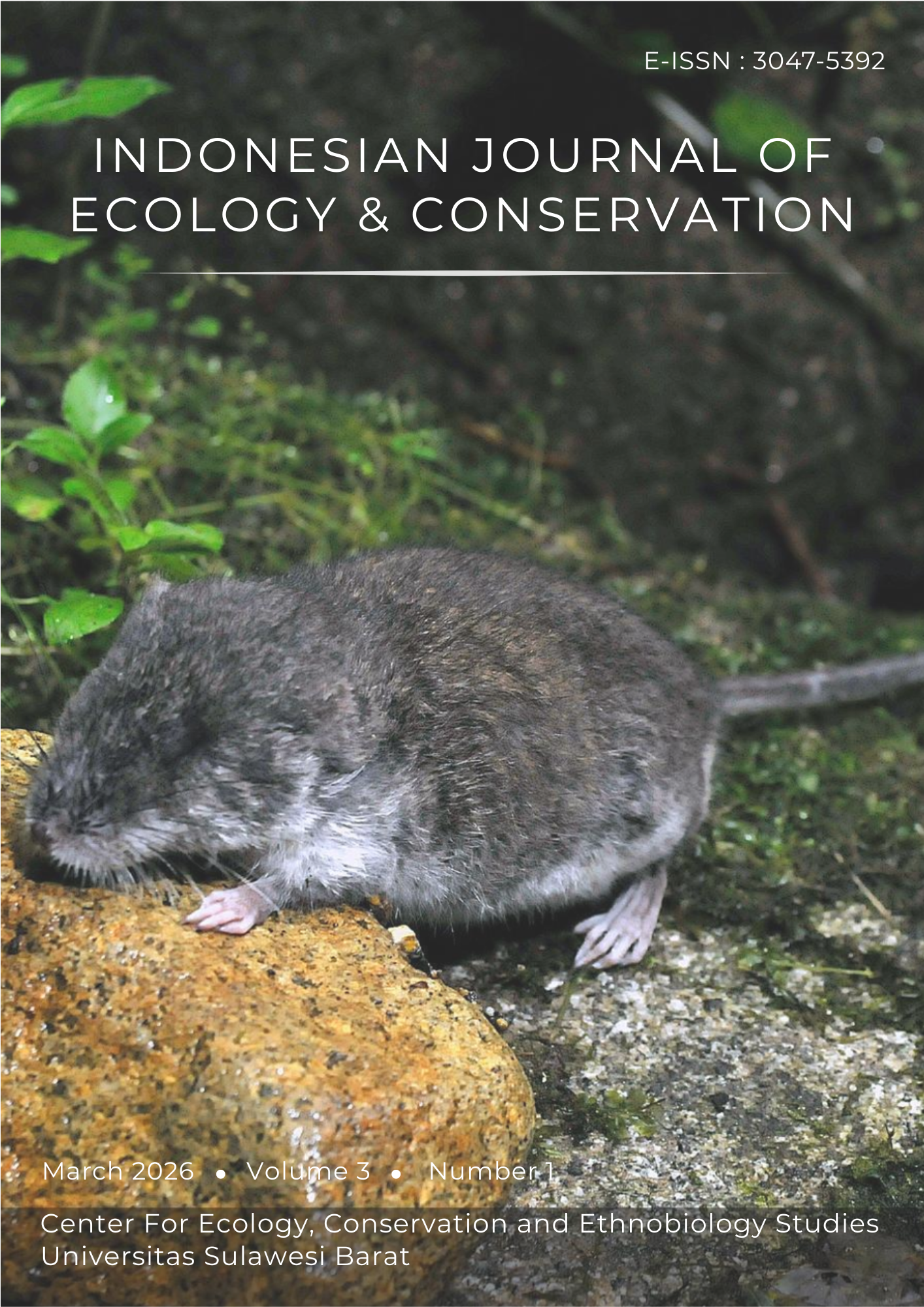
Bat community composition and habitat-associated niche differentiation in a tropical island ecosystem of Wakatobi, Indonesia
DOI:
https://doi.org/10.31605/ijec.v3i1.6363Keywords:
Abundance, Chiroptera, Habitat, Species diversity, WakatobiAbstract
Bats (Chiroptera) play important ecological roles in tropical island ecosystems, yet information on their community structure in small island systems remains limited. This study aims to analyze species composition, abundance, and habitat associations of bat communities in Wakatobi. Field surveys were conducted in September 2023 across three islands (Wangi-wangi, Kaledupa, and Tomia) using a combination of mist nets and roost observations. A total of 10 sampling points were established, consisting of 5 cave sites, 3 mangrove sites, and 2 terrestrial vegetation sites, with one mist net deployed at each point. Data were analyzed using diversity indices (Shannon-Wiener and Simpson), descriptive abundance analysis, and multivariate approaches including Principal Component Analysis (PCA) and PERMANOVA. A total of 1,604 individuals representing five species from three genera (Pteropus, Rousettus, and Hipposideros) were recorded. The community was strongly dominated by frugivorous bats, particularly Pteropus pumilus (84.47%), which was primarily associated with mangrove and terrestrial vegetation habitats. In contrast, cave habitats were dominated by insectivorous species such as Hipposideros galeritus. Diversity indices indicated low species diversity but high dominance, especially in mangrove habitats. PCA results revealed a clear ecological gradient separating vegetation and cave habitats, with the first two components explaining 100% of total variation (Dim1 = 71.7%; Dim2 = 28.3%). These findings demonstrate strong habitat-driven community structuring and niche differentiation among bat species. This study represents the first assessment of bat community structure in Wakatobi using a PCA-based multivariate approach, providing new insights into habitat–species relationships in small island ecosystems. The results highlight the importance of conserving mangrove and cave habitats as complementary systems supporting bat diversity and ecosystem functions.
References
Altringham, J. (2011). Bats: From Evolution to Conservation. Oxford University Press. https://doi.org/10.1093/acprof:osobl/9780199207114.001.0001
Arjunari, F., Hadi, I., & Syaputra, M. (2018). Identifikasi jenis dan karakteristik habitat kelelawar di Gua Tanjung Pasir Taman Buru Pulau Moyo. Universitas Mataram.
Armiani, S., & Fajri, S. R. (2020). Bioscientist: Jurnal Ilmiah Biologi, 8(2), 371–380.
Asriadi, A. (2010). Kelimpahan, sebaran, dan keanekaragaman jenis kelelawar (Chiroptera) pada beberapa gua dengan pola pengelolaan berbeda di kawasan karst Gombong Jawa Tengah. Universitas Islam Negeri Syarif Hidayatullah Jakarta.
Az-Zahra, N., Alifah, F., Noorfamaza, A., Nurrohimah, K., Novitasari, N., Maharani, F. E., Oktaviani, V. I., Jasinda, R. C., Azzahra, S. A., Siagian, S. D. A., & Prakarsa, T. B. P. (2023). Cave bats (yangochiroptera and yinpterochiroptera) in gunung sewu geopark: study of karst caves in wonogiri regency. Deleted Journal, 1(1), 15–23. https://doi.org/10.21831/ijobi.v1i1.107
Bumbut, P. I., Kartono, A. P., & Maryanto, I. (2016). Keanekaragaman jenis dan pemanfaatan sumberdaya oleh kelelawar sub ordo Megachiroptera di Taman Wisata Alam Gunung Meja Manokwari, Papua Barat. Jurnal Biologi Indonesia, 12(1), 99–117.
Firmansyah, F., Musthofa, A., Estradivari, D., Handayani, C., Ahmadia, G., & Haris, J. (2016). Satu dekade pengelolaan Taman Nasional Wakatobi: Keberhasilan dan tantangan konservasi laut. WWF-ID.
Flaquer, C., Torre, I., & Arrizabalaga, A. (2007). Comparison of Sampling Methods for Inventory of Bat Communities. Journal of Mammalogy, 88(2), 526–533. https://doi.org/10.5281/zenodo.13475631
Fleming, G. M., Ramsay, E. E., Putra Nurdin, M. R. T. J., Duffy, G. A., Faber, P. A., & Chown, S. L. (2024). Sensitivity of insectivorous bat foraging guilds to urbanization and implications for sustainable development. Global Ecology and Conservation, 51, e02929. https://doi.org/10.1016/j.gecco.2024.e02929
Giarla, T. C., Achmadi, A. S., Fabre, P.-H., Handika, H., Chipps, A. S., Swanson, M. T., Nations, J. A., Morni, M. A., William-Dee, J., & Inayah, N. (2025). Systematics and historical biogeography of Crunomys and Maxomys (Muridae: Murinae), with the description of a new species from Sulawesi and new genus-level classification. Journal of Mammalogy, 106(4), 832–858. https://doi.org/10.1093/jmammal/gyafo06
Gotelli, N. J., & Ellison, A. M. (2013). A primer of ecological statistics (2nd ed.). Sinauer Associates.
Graf, S. (2010). Diversity and habitat use of understorey bats in forest and agroforestry systems at the margin of Lore Lindu National Park (Central Sulawesi, Indonesia). https://othes.univie.ac.at/11947/
Ingala, M. R., Oliveira, H. F. M., Frank, L. A., Hussain, M., Kazam, A., Becker, D. J., Cummings, C., Dalannast, M., Kingston, T., Krauel, J. J., Mavian, C., McKee, C., Perea, S., Rivera‐Villanueva, A. N., Schaer, J., Speer, K. A., Toshkova, N., Tsang, S. M., Wray, A. K., … Lauterbur, M. E. (2025). Bats in Habitats, Bats as Habitats: An integrative ecological framework for understanding synergistic interactions across levels of community organization. https://doi.org/10.32942/x2rw59
Jolliffe, I. T., & Cadima, J. (2016). Principal component analysis: A review and recent developments. Philosophical Transactions of the Royal Society A: Mathematical, Physical and Engineering Sciences, 374(2065), 20150202. https://doi.org/10.1098/rsta.2015.0202
Kasso, M., & Balakrishnan, M. (2013). Ecological and Economic Importance of Bats (Order Chiroptera). ISRN Biodiversity, 2013, 1–9. https://doi.org/10.5281/zenodo.14822108
Kunz, T. H., & Lumsden, L. F. (2003). Ecology of cavity and foliage roosting bats. In Bat Ecology (pp. 3–89). University of Chicago Press. https://doi.org/10.5281/zenodo.4655329
Kunz, T. H., Braun de Torrez, E., Bauer, D., Lobova, T., & Fleming, T. H. (2011). Ecosystem services provided by bats. Annals of the New York Academy of Sciences, 1223, 1–38. https://doi.org/10.1111/j.1749-6632.2011.06004.x
Legendre, P., & Legendre, L. (2012). Numerical ecology (3rd ed.). Elsevier.
Maulany, R. I., Wolor, F. S., Nasri, N., & Achmad, A. (2019). Habitat Characteristics and Population of cave-dwelling bats in Mara Kallang Cave of Maros-Pangkep Karst Area of South Sulawesi. 270(1), 012030. https://doi.org/10.1088/1755-1315/270/1/012030
Mubarok, H., Maryanto, I., & Perwitasari, D. P. F. (2018). Morfometri kelelawar pemakan buah (Chiroptera, Thoopterus) Sulawesi Selatan. Prosiding Seminar Nasional Jurusan Pendidikan Biologi.
Muscarella, R., & Fleming, T. H. (2007). The role of frugivorous bats in tropical forest succession. Biological Reviews, 82(4), 573–590. https://doi.org/10.1111/j.1469-185X.2007.00026.x
Mustari, A. H. (2020). Manual identifikasi dan bio-ekologi spesies kunci di Sulawesi. IPB Press.
Portfors, C. V., Fenton, M. B., Aguiar, L. M. D. S., Baumgarten, J. E., Vonhof, M. J., Bouchard, S., Faria, D. M. D., Pedro, W. A., Rauntenbach, N. I. L., & Zortea, M. (2000). Bats from Fazenda Intervales, Southeastern Brazil: species account and comparison between different sampling methods. Revista Brasileira De Zoologia, 17(2), 533–538. https://doi.org/10.5281/zenodo.13435113
Pratiwi, A. P., Wicaksono, D. B., Martiningsih, I., Indriyani, S., Joharina, A. S., & Yacob, Y. (2020). Kelelawar Megachiroptera sebagai reservoir Lyssavirus di Provinsi Riau. Jurnal Hutan Lestari, 8(2), 429–440.
Putera, A. K. S., & Isdaryanti, I. (2024). Distribusi dan inventarisasi keanekaragaman jenis burung di kawasan Kampus Universitas Sulawesi Barat dan sekitarnya. Indonesian Journal of Ecology and Conservation, 1(1). https://doi.org/10.31605/ijec.v1i1.3715
Qaanitah, I., Yustian, I., & Kamal, M. (2018). Identifikasi kelelawar berdasarkan morfologi dan morfometri di kawasan Kampus Universitas Sriwijaya, Indralaya. Jurnal Penelitian Sains, 20(3), 71–76.
Rabbani Ismaili, R. R., Rabbani Ismaili, O. M., Khan, M., & Amine, M. (2023). Bats in focus: unveiling the conservation imperative and ecological significance. Indian Journal of Scientific Research. https://doi.org/10.32606/ijsr.v14.i1.0001 1
Ransaleleh, T. A., Kawatu, H. M., & Wahyuni, I. (2022). Pertumbuhan flying fox (Chiroptera: Pteropodidae) dalam kandang. Universitas Sam Ratulangi.
Ransaleleh, T. A., Maheswari, R. R. A., Sugita, P., & Manalu, W. (2013). Identifikasi kelelawar pemakan buah asal Sulawesi berdasarkan morfometri. Jurnal Veteriner, 14(4), 485–494.
Safitri, Z., Prayogo, H., & Erianto. (2020). Bats (Chiroptera) diversity in Tanjungpura University Area, Pontianak. Jurnal Hutan Lestari, 8(2), 429–440.
Sampaio, E. M., Kalko, E. K. V., Bernard, E., Rodr�guez-Herrera, B., & Handley, C. O. (2003). A Biodiversity Assessment of Bats (Chiroptera) in a Tropical Lowland Rainforest of Central Amazonia, Including Methodological and Conservation Considerations. Studies on Neotropical Fauna and Environment, 38(1), 17–31
Soliman, K. M., & Emam, W. W. (2022). Bats and Ecosystem Management. https://doi.org/10.5772/intechopen.101600
Suparman, S., Putra Nurdin, M. R. T. J., & Fausan, M. M. (2024). Diversitas dan distribusi spasial kumbang tinja (Coleoptera: Scarabaeidae) pada dua tipe habitat di Sulawesi Barat. Indonesian Journal of Ecology and Conservation, 1(2). https://doi.org/10.31605/ijec.v1i2.6319
Wiantoro, S., Hitch, A.T., Engilis, I.E., Gunawan, H., & Engilis, A. (2017). Bats (Chiroptera) recorded in the lowland of Southeast Sulawesi, Indonesia with notes on taxonomic status and significant range extensions. Mammalia, 81, 385 - 400.
Yuliadi, B., Sari, T. F., & Handayani, F. D. (2018). Kelelawar Sulawesi: Jenis dan peranannya dalam kesehatan. Lembaga Penerbit Badan Penelitian dan Pengembangan Kesehatan Kementerian Kesehatan RI