Publication Ethics
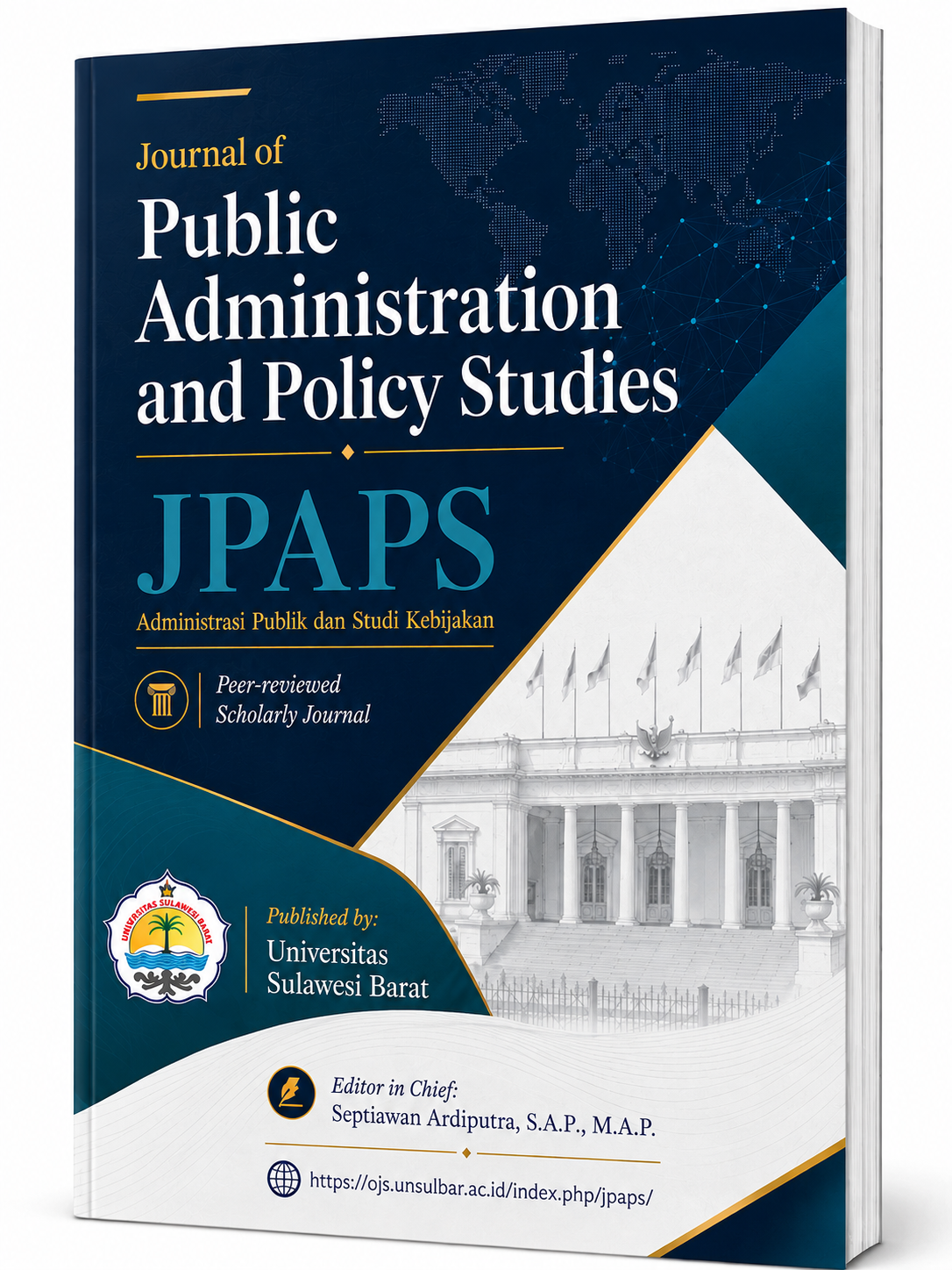
Journal of Public Administration and Policy Studies (JPAPS) is committed to maintaining high standards of publication ethics, academic integrity, editorial independence, and transparency throughout the scholarly publishing process. JPAPS adopts relevant guidance and core practices of the Committee on Publication Ethics (COPE) in addressing ethical issues related to authorship, peer review, editorial decision-making, conflicts of interest, research integrity, misconduct, corrections, and retractions.
All parties involved in the publication process, including authors, editors, reviewers, and the publisher, are expected to uphold the principles of honesty, fairness, accountability, confidentiality, transparency, and respect for the integrity of the scholarly record.
1. Responsibilities of Editors
Editors are responsible for ensuring that manuscripts submitted to JPAPS are evaluated fairly, objectively, independently, and solely on the basis of their scholarly quality, originality, relevance to the journal's aims and scope, methodological rigor, and contribution to knowledge.
Editorial decisions must not be influenced by an author's nationality, institutional affiliation, gender, ethnicity, religion, political views, or other personal characteristics unrelated to the scholarly merit of the manuscript.
Editors must maintain the confidentiality of submitted manuscripts and may disclose information about a manuscript only to individuals directly involved in the editorial and peer-review process.
Editors must disclose any actual, potential, or perceived conflict of interest. An editor who has a conflict of interest concerning a manuscript must withdraw from handling the manuscript, and editorial responsibility must be assigned to another qualified editor.
Editors are responsible for safeguarding the independence and integrity of the peer-review and editorial decision-making processes. Acceptance or rejection decisions must not be influenced by commercial, institutional, personal, or other inappropriate considerations.
2. Responsibilities of Reviewers
Reviewers are expected to provide objective, constructive, evidence-based, and timely evaluations of manuscripts within their areas of expertise.
All manuscripts and related materials received for review must be treated as confidential. Reviewers must not disclose, reproduce, distribute, discuss, or use unpublished information contained in a manuscript for personal, professional, or competitive advantage.
Reviewers should assess manuscripts impartially and provide comments that assist authors in improving the scholarly quality of their work. Personal criticism, discriminatory comments, offensive language, or unsupported judgments are unacceptable.
Reviewers should identify relevant published work that has not been appropriately acknowledged and should inform the editor if they identify or suspect plagiarism, duplicate publication, fabrication, falsification, citation manipulation, undisclosed conflicts of interest, or other forms of research or publication misconduct.
Reviewers must disclose any conflict of interest that could affect, or reasonably be perceived to affect, the impartiality of their review and should decline the review when appropriate.
Reviewers must not upload submitted manuscripts, manuscript excerpts, supplementary materials, review reports, or other confidential editorial information into generative artificial intelligence systems. Artificial intelligence tools must not be used to conduct, replace, or generate the substantive peer review of manuscripts.
3. Responsibilities of Authors
Authors must ensure that manuscripts submitted to JPAPS constitute original scholarly work and accurately represent the research, analysis, evidence, and interpretations on which the manuscript is based.
Authors are responsible for the accuracy and integrity of all data, evidence, citations, analyses, and statements presented in their manuscripts. Fabrication, falsification, inappropriate manipulation of data or evidence, selective or misleading reporting, plagiarism, citation manipulation, and other forms of academic misconduct are unacceptable.
A manuscript must not have been published previously in substantially the same form and must not be under consideration by another journal at the same time.
Authors must appropriately acknowledge and cite the ideas, data, methods, arguments, and publications of others. Sources must be represented accurately and references must be relevant and verifiable.
Authors are responsible for disclosing all relevant sources of research funding and any financial, professional, institutional, personal, or other interests that could reasonably be perceived as influencing the research or its interpretation.
4. Authorship and Contributorship
Authorship should be limited to individuals who have made substantial scholarly contributions to the conception, design, execution, analysis, interpretation, or preparation of the work and who are willing to take responsibility for their contributions.
All listed authors must approve the submitted version of the manuscript and agree to its submission to JPAPS.
Guest authorship, gift authorship, honorary authorship, and ghost authorship are not permitted. Individuals who contributed to the work but do not meet the criteria for authorship should be appropriately acknowledged, subject to their consent where necessary.
Requests to add, remove, or rearrange authors after submission must be supported by a clear explanation and agreement from all affected authors. The journal reserves the right to request further documentation before approving authorship changes.
5. Originality, Plagiarism, and Duplicate Publication
JPAPS publishes original scholarly work. Plagiarism, self-plagiarism, inappropriate text recycling, redundant publication, duplicate publication, and simultaneous submission to multiple journals constitute violations of publication ethics.
Submitted manuscripts may be screened using plagiarism-detection software as part of the editorial process.
Detailed procedures and requirements relating to similarity checking are provided separately in the journal's Plagiarism Screening Policy.
6. Research Integrity and Data Responsibility
Authors must maintain the integrity of the research process and scholarly record. Data, documents, interview materials, survey responses, administrative records, statistical results, and other forms of evidence must be collected, analyzed, interpreted, and reported responsibly.
Fabrication of data or evidence, falsification of research materials or results, inappropriate manipulation of data, deliberate omission of relevant findings, and misleading presentation of results are prohibited.
Where appropriate and legally permissible, authors should retain sufficient research documentation to support the reliability and traceability of their findings and should respond appropriately to reasonable editorial requests concerning the verification of research materials or analyses.
Authors must respect legal, ethical, contractual, confidentiality, and privacy restrictions governing access to and use of research data.
7. Research Ethics and Ethical Approval
Research involving human participants, interviews, surveys, focus-group discussions, observations, personal or sensitive information, vulnerable groups, or other activities requiring ethical oversight must comply with applicable ethical principles, institutional requirements, and relevant laws and regulations.
Where formal ethical approval is required, authors must provide information concerning the approving institution or ethics committee and, where applicable, the approval reference number.
Where formal ethical approval is not required or is not applicable under the relevant institutional or national framework, authors should provide an appropriate statement when requested by the journal.
Informed consent must be obtained where applicable. Authors are responsible for protecting the privacy, confidentiality, dignity, safety, and rights of research participants.
Research using government records, administrative data, policy documents, publicly available datasets, digital data, or other secondary sources must comply with applicable access conditions, privacy requirements, data-protection principles, and ethical standards.
8. Conflicts of Interest
Authors, editors, and reviewers must disclose any financial, institutional, professional, personal, academic, or other relationship that could influence—or reasonably be perceived to influence—the research, peer-review process, or editorial decision.
Potential conflicts of interest will be managed transparently and, where necessary, the individual concerned will be excluded from the relevant evaluation or decision-making process.
Failure to disclose a relevant conflict of interest may result in editorial action before or after publication.
9. Research and Publication Misconduct
JPAPS takes allegations of research and publication misconduct seriously.
Potential misconduct may include, but is not limited to, plagiarism, fabrication, falsification, inappropriate manipulation of data or evidence, duplicate publication, citation manipulation, inappropriate authorship, undisclosed conflicts of interest, unethical research practices, manipulation of the peer-review process, or other conduct that compromises the integrity of the scholarly record.
Suspected misconduct will be examined fairly and confidentially. Authors and other relevant parties may be requested to provide explanations or supporting documentation.
Depending on the nature and seriousness of the matter, editorial action may include rejection of the manuscript, suspension of the editorial process, correction of the published record, expression of concern, retraction, or other appropriate measures. Where justified, the journal may communicate with the relevant institution or other appropriate authority in accordance with applicable ethical procedures.
10. Corrections, Retractions, and the Integrity of the Scholarly Record
JPAPS is committed to maintaining an accurate and trustworthy scholarly record.
When significant errors are identified after publication, the journal may issue a correction or other appropriate notice.
When published findings are demonstrated to be unreliable as a result of major error, fabrication, falsification, plagiarism, unethical research, duplicate publication, manipulation of the publication process, or other serious concerns, the journal may retract the article in accordance with recognized publication-ethics principles.
Where substantial concerns remain unresolved while an investigation is ongoing, an expression of concern may be issued when appropriate.
Corrections, retractions, and other post-publication notices will be clearly identified and linked to the original publication wherever technically possible.
11. Complaints and Appeals
Authors, reviewers, readers, and other parties may submit complaints concerning the journal's editorial process, ethical procedures, or published content.
Authors may also appeal an editorial decision when they believe that a substantive error has occurred in the review or decision-making process. An appeal must provide clear academic or procedural grounds and should not merely express disagreement with the editorial decision.
Complaints and appeals will be handled fairly, confidentially, and without retaliation. Where appropriate, they will be reviewed by an editor or other qualified individual who was not directly responsible for the matter under consideration.
The submission of an appeal does not guarantee reversal of the original editorial decision.
12. Artificial Intelligence and AI-Assisted Technologies
The responsible use of artificial intelligence and AI-assisted technologies in scholarly publishing is governed by the journal's separate AI Policy.
Authors must comply with the journal's requirements concerning the use and disclosure of AI-assisted technologies in manuscript preparation.
Artificial intelligence systems cannot be credited as authors because they cannot assume responsibility, accountability, or legal responsibility for scholarly work.
Editors and reviewers must protect manuscript confidentiality and must not use generative AI systems to perform or generate substantive peer review or editorial evaluation of submitted manuscripts.
13. Editorial Independence
Editorial decisions concerning individual manuscripts are made independently on the basis of scholarly considerations.
The publisher, sponsoring institution, financial considerations, political interests, personal relationships, or other external parties must not interfere with editorial decisions concerning the acceptance or rejection of individual manuscripts.
The Editor-in-Chief and Editorial Team are responsible for preserving the academic independence, integrity, and credibility of JPAPS.
14. Responsibilities of the Publisher
The publisher supports the editorial independence of Journal of Public Administration and Policy Studies (JPAPS) and is committed to maintaining ethical publishing practices, transparency, long-term accessibility of published content, and the integrity of the scholarly record.
The publisher will support appropriate editorial procedures for addressing ethical concerns, corrections, retractions, complaints, and allegations of misconduct and will not interfere improperly with independent editorial decisions.
15. Commitment to Publication Ethics
JPAPS regards publication ethics as a continuing responsibility rather than a requirement limited to the submission and publication stages.
The journal reserves the right to investigate ethical concerns arising before or after publication and to take appropriate action in order to protect research integrity, editorial independence, the rights of research participants, and the reliability of the scholarly record.