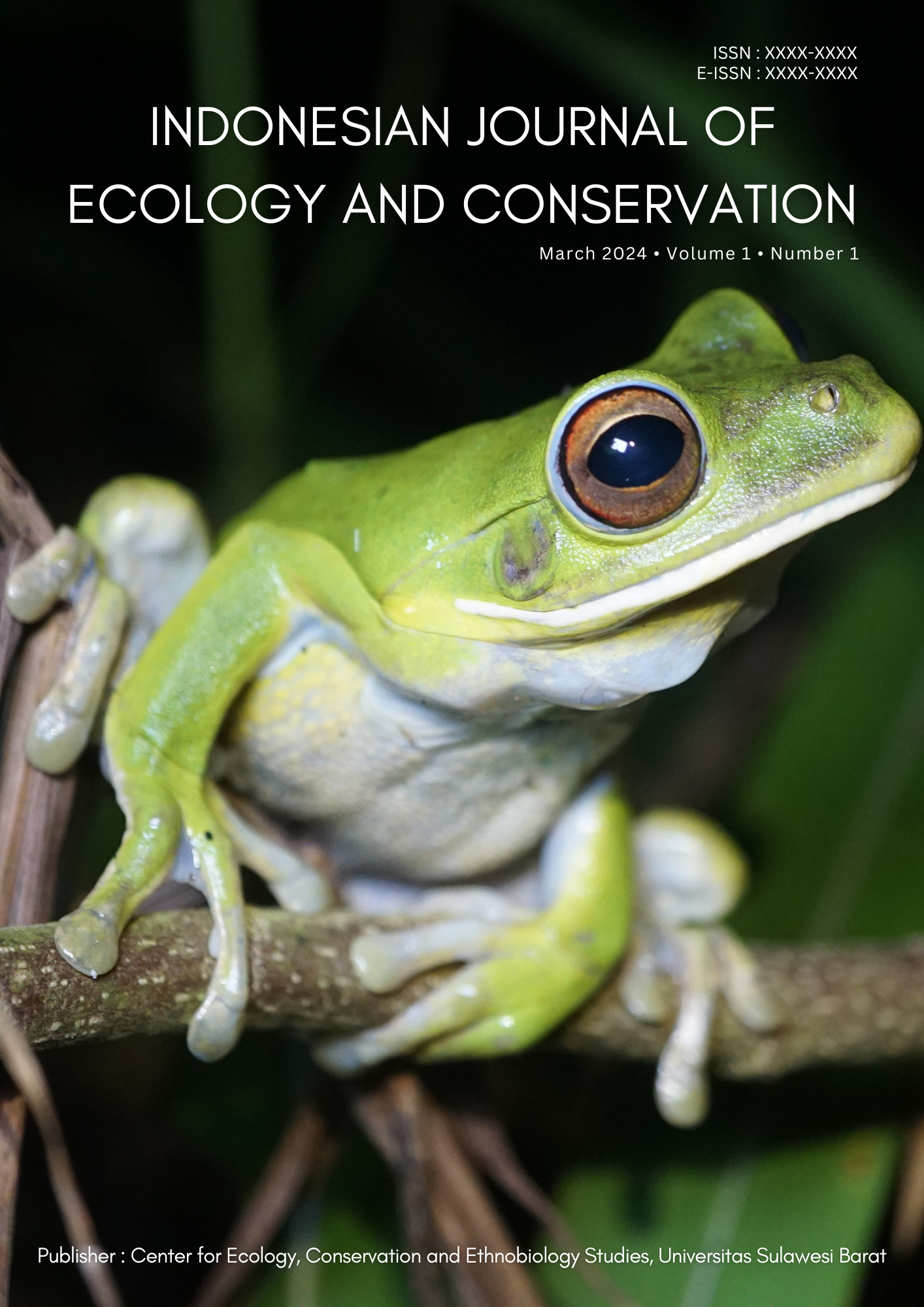
Effects of Herbicide Application on the Soil Seed Bank in the Bekol Savanna of Baluran National Park
DOI:
https://doi.org/10.31605/ijec.v1i1.3712Keywords:
Baluran National Park, Fluroksipir, Herbicide, Seedbank, TriklopirAbstract
The dominance of broadleaf weeds after A. nilotica control resulted in a decrease in the dominance of grass species in the savanna area of Bekol BNP. Herbicide application for controlling broadleaf weeds is an effective and efficient method. However, the impact of herbicide use on seed storage in the soil is unknown, while seed storage plays an important role in the sustainability of vegetation. This study used a completely randomized factorial design with three factors: soil depth, type of herbicide, herbicide concentration, and a control (without herbicide application). The effect of herbicide application on seed germination was analyzed using ANOVA. The results of this study indicated that the application of herbicides had no significant effect on seed germination in the soil (P > 0.05). Therefore, the use of triclopyr and fluroxypyr herbicides could be considered as one of the measures for controlling broadleaf weeds in the savanna area of BNP.
References
Baskin, C. C., & Baskin, J. M. (2001). Seeds: Ecology, biogeography, and evolution of dormancy and germination. Academic Press.
Batlla, D., & Benech-Arnold, R. L. (2007). Predicting changes in dormancy level in weed seed soil banks: Implications for weed management. Crop Protection, 26(3), 189–197.
Brock, M. A., Theodore, K., & O’Donnell, L. (1994). Seed-bank methods for Australian wetlands. Marine and Freshwater Research, 45(4), 483–493.
Chauhan, B. S., Campbell, S., & Galea, V. J. (2021). Seed germination biology of sweet acacia (Vachellia farnesiana) and response of its seedlings to herbicides. Weed Science, 69(6), 681–686.
Dessaint, F., Chadoeuf, R., & Barralis, G. (1997). Nine years’ soil seed bank and weed vegetation relationships in an arable field without weed control. Journal of Applied Ecology, 34, 123–130.
Djufri, D. (2009). Penurunan kualitas savana Bekol sebagai feeding ground bagi rusa (Cervus timorensis) dan banteng (Bos javanicus) di Taman Nasional Baluran, Jawa Timur. Biologi Edukasi: Jurnal Ilmiah Pendidikan Biologi, 1(2), 29–33.
Espinar, J. L., Thompson, K., & García, L. V. (2005). Timing of seed dispersal generates a bimodal seed bank depth distribution. American Journal of Botany, 92, 1759–1763.
Feledyn-Szewczyk, B., Smagacz, J., Kwiatkowski, C. A., Harasim, E., & Woźniak, A. (2020). Weed flora and soil seed bank composition as affected by tillage system in three-year crop rotation. Agriculture, 10(5), 186.
Humphries, T., Chauhan, B. S., & Florentine, S. K. (2018). Environmental factors affecting the germination and seedling emergence of two populations of an aggressive agricultural weed, Nassella trichotoma. PLoS ONE, 13(7), e0199491.
Liebman, M., Nguyen, H. T., Woods, M. M., Hunt, N. D., & Hill, J. D. (2021). Weed seedbank diversity and sustainability indicators for simple and more diverse cropping systems. Weed Research, 61(3), 164–177.
Moenandir, Y. (1990). Pengantar ilmu dan pengendalian gulma. Rajawali Press.
Muis, N., Setyawati, T., Tjitrosoedirdjo, S., & Ratnadewi, Y. M. D. (2018). Estimating the abundance and composition of soil seed bank at Bekol Savanna in Baluran National Park, East Java. Jurnal Penelitian Kehutanan Wallacea, 7(2), 131–140.
Qirom, M. A., Andriani, S., Azwar, F., & Octavia, D. (2007). Pengaruh pembebasan jenis akasia berduri Acacia nilotica (L.) Willd. ex Del terhadap komposisi jenis tumbuhan penyusun savana dan kualitas savana di Taman Nasional Baluran, Jawa. Jurnal Penelitian Hutan dan Konservasi Alam, 4(6), 573–582.
Radosevich, S. R., Holt, J. S., & Ghersa, C. M. (2007). Ecology of weeds and invasive plants: Relationship to agriculture and natural resource management. John Wiley & Sons.
Saputri, R. (2016). Efektivitas herbisida triklopir dan fluroksipir untuk pengendalian gulma berdaun lebar di kawasan Savana Bekol Taman Nasional Baluran (Tesis, Institut Pertanian Bogor).
Tjitrosoedirdjo, S., Mawardi, I., Setiabudi, Syaiful, & Tjitrosoedirdjo, S. S. (2013). Chemical control of Acacia nilotica under medium density regime populations and broadleaved weeds in Bekol Savanna, Baluran National Park, East Java, Indonesia. In B. Bakar, D. Kurniadi, & S. Tjitrosoediro (Eds.), The role of weed science in supporting food security by 2020 (pp. 264–270). Proceedings of the 23rd Asian-Pacific Weed Science Society Conference.
Travlos, I., Gazoulis, I., Kanatas, P., Tsekoura, A., Zannopoulos, S., & Papastylianou, P. (2020). Key factors affecting weed seeds’ germination, weed emergence, and their possible role for the efficacy of false seedbed technique as weed management practice. Frontiers in Agronomy, 2, 1.